19 Jun Your Puppy at 12 weeks: What to Expect (And What to Actually Do)
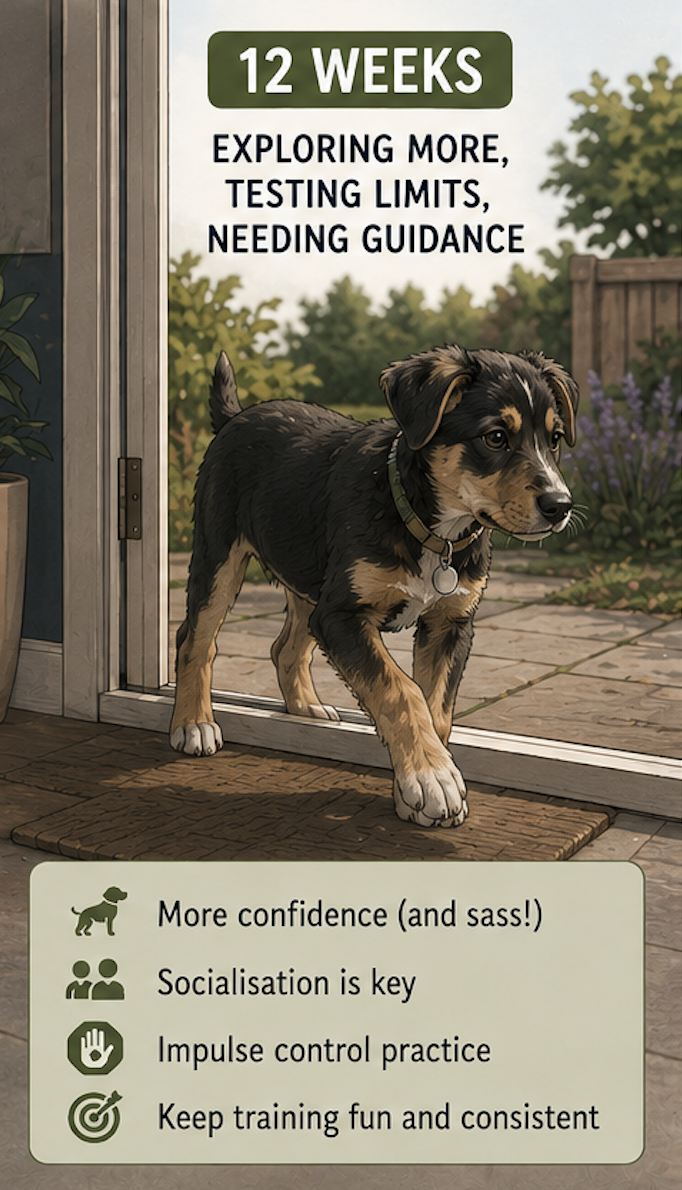
12 Weeks: Curious, Confident and Getting Into Absolutely Everything
What’s happening!?
By 12 weeks most puppies are now more confident. Those wobbly baby movements have been replaced by sudden bursts of speed, impressive cornering (flooring dependant) and an apparent determination to investigate every inch of your home…at top speed.
Your puppy is moving into a phase of greater confidence and curiosity. They’re becoming more independent, adventurous and interested in the world around them. They’re also starting to work out who they are, what they enjoy and what the rules of the home are.
Spoiler alert; they will test all of them!
Teething will really ramp up, although adult teeth don’t typically start arriving until about 16 weeks but the process has started. This means that chewing will start becoming more frequent. This includes (but not limited to) furniture, toys, blankets and hands. As far as your pup is concerned, everything is a potential chew toy until they learn otherwise.
At the same time, your puppy is becoming more social. They’re showing greater interest in everything happening around them. Their confidence is growing and their personality is emerging.
This is often typically when more formal training, like puppy classes or individual one to one training sessions start.
The challenge for owners is that confidence and curiosity don’t always come with good decision making. Since the puppy wants to explore everything…including things you’d rather they didn’t.
What to actually do
Build on the basics – By 12 weeks, your puppy is ready to start really establishing those early foundations. Including, but not limited to, sit, down, recall, name response, loose lead walking all of these can be introduced and practiced in short, fun training sessions.
When I say short, I mean short! Five minutes is plenty, ten is probably pushing it.
At this point training should feel less like a lesson and more natural, almost like a game your puppy keeps winning. Use rewards, keep sessions positive and try to finish while the puppy is still enjoying themselves. The goal isn’t perfection but to start the puppy discovering that paying attention to you is worthwhile.
Consider a puppy class – If you haven’t considered a puppy class this is often the perfect time. A good class should teach not only cues but also allow your pup to experience new people, environments and other puppies in a safe, controlled setting.
It’s also a chance to discover other owners dealing with the same chaos. While this can be reassuring, try not to fall into the trap of comparing your pup to others. Every pup develops at their own pace.
When choosing a class, look for one that uses positive, reward-based methods. Most trainers will be happy for you to watch a session before committing.
Take socialisation seriously – While your puppy’s socialisation window is still open, it’s gradually narrowing.
Please don’t suddenly rush out to expose them to everything all in one weekend! Instead, think about the things your puppy is likely to encounter throughout their life and introduce them thoughtfully. The list can be surprisingly long and I will probably do a separate blog to list them all out!
Work through these experiences at your puppy’s pace and focus on creating positive associations. The goal isn’t simply exposure but to help feel comfortable and confident around the things they’ll encounter in everyday life.
Provide plenty of chewing opportunities – Keep giving your pup plenty of appropriate outletlets for this. This includes (but not limited to) puppy safe chews, food toys, enrichment activities and puzzle feeders.
A puppy who has suitable things to chew is generally less likely to chew things like skirting boards or shoes…no promises though!
Establish a predictable routine – Puppies thrive on predictability. Knowing when meals arrive, when walks happen, when it’s playtime and time to rest. They find it reassuring.
That said, it’s worth building in a little flexibility too. Life happens, walks run late, visitors turn up (for the puppy) and generally plans change. A puppy who experiences small variations in their routine is more likely to cope well when things don’t go to plan.
If your puppy is currently chewing a table leg, stealing socks, and investigating parts of the house you didn’t even know existed, you’re not alone.
At twelve weeks, curiosity is at an all-time high and common sense is still very much a work in progress.
I offer puppy training and one-to-one sessions across Christchurch, Bournemouth, Poole, New Milton, Ringwood, and the wider Dorset and Hampshire area, tailored to you and your puppy.
[Get in touch here] to find out how I can help, or learn more about my [puppy training].
*Picture generated by AI
No Comments