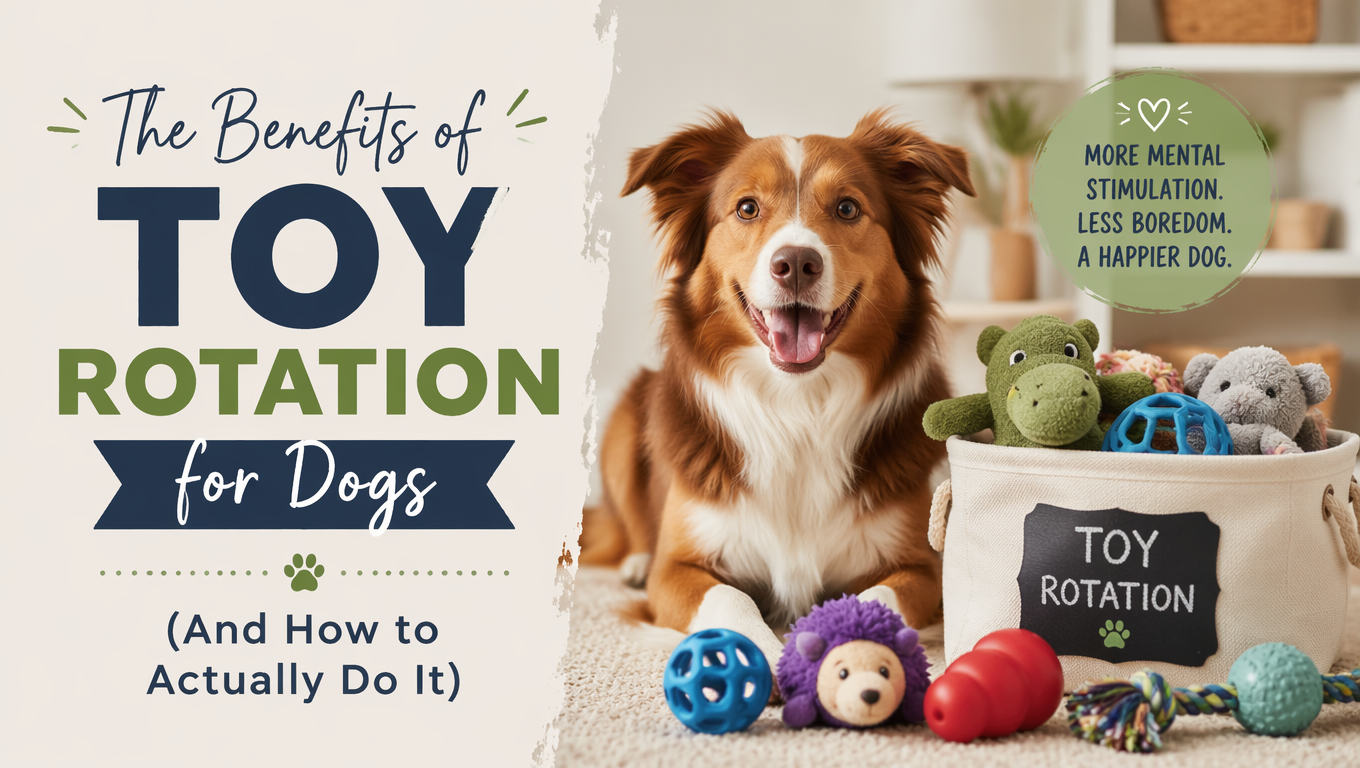
21 Jul The Benefits of Toy Rotation for Dogs (And How to Actually Do It)
Your Dog Isn’t Bored Because They’re Naughty. They’re Bored Because They’re Smart.
Here’s a scenario that might seem familiar.
You’ve bought the toys, like rope toys, squeaky toys and balls. Perhaps something that dispenses treats that your dog worked out how to empty in about four minutes and is now indifferent to it.
Initially the toys are carried around the house and there is one that is their favourite and treated like a priceless treasure.
And then…nothing. The toys are abandoned, ignored and your dog has moved on to investigating your skirting board, destroying your cushions and chewing your shoes.
Your dog is not ungrateful or naughty but bored. Dogs are naturally curious, problem-solving animals. When their environment has not got enough novelty then dogs can create their own entertainment. Unfortunately when they choose these ‘hobbies’ they are not always something owners want.
The good news is that one of the simplest, cheapest, and most effective ways to keep your dog engaged is something you can start today! It’s called toy rotation.
What Is Toy Rotation?
Toy rotation is exactly what it sounds like.
So, instead of leaving all the toys your dog has scattered around the house at all times, you keep a small selection available and put the rest away.
Every few days, or weeks depending on your dog, you swap them over.
Those toys that you put away make their grand return…and that’s it!
So, why does it work? Well…novelty.
Because dogs are naturally curious, when a toy has been sitting on the floor for a while it becomes not novel anymore which means it often gets ignored.
But when you bring that same toys back after some time away then something interesting happens. Your dog starts to pay attention again. The toy itself hasn’t changed but the novelty has.
There is actually research into this, a study by Wells (2004) shows that rotating enrichment items helps encourage exploratory behaviour far more effectively than leaving the same toys available all the time (here is the full study, if you want to have a read).
In other words your dog isn’t necessarily bored of toys, it’s more the same toys, which is a much easier problem to solve!
Why It Matters More Than You Might Think
When most people think about a dog’s needs they tend to focus on physical exercise like walks and playing.
While physical exercise is important, it’s only part of the picture. Mental stimulation matters too, for many dogs it’s the missing piece of the puzzle.
Many of the behaviour issues owners seek help for are not rooted in either disobedience or stubbornness. Sometimes they are the result of a dog who is under-stimulated and looking for something to do.
The signs can be surprising easy to miss…until they become a problem, such as:
- Destructive chewing of furniture, shoes or door frames
- Excessive barking or whining
- Escalating attention-seeking behaviours
- Persistent pacing or restlessness even if they’ve had a lot of physical exercise.
Something that can surprise a lot of owners is that a dog can come home from a long walk and still be bored as physical exercise and mental stimulation aren’t the same thing.
That’s because activities like sniffing, problem-solving, learning and exploring require effort. They engage the brain in ways that walking doesn’t.
It’s best to try and think of it as dogs having two energy bars, physical (for tiring out their body) and mental (for tiring out their brain) most dogs need both.
A dog with interesting things to think about is a dog who spends less time to find their own entertainment, this is a win for you, your dog and your furniture!
How to Set Up a Simple Toy Rotation
The good news is that toy rotation doesn’t require anything complicated or a spreadsheet, simply a place to put toys that the dog can’t access and the ability to be organised.
Step 1: Gather all of your dogs’ toys in one place…all of them.
It’s important to take stock of what you have before buying anything new. Even toys you feel your dog has completely lost interest in, those are the ones that often benefit most from a rotation.
Step 2: Sort them into categories. It helps to have a variety of different toy types available rather than offering ten versions of the same thing.
Categories can include
Chew toys, such as rubber chews or long lasting chews.
Interactive toys, such as rope toys, tug toys or balls.
Enrichment toys, such as treat-dispensing toys, snuffle mats or food puzzles.
Comfort toys, such as plush toys, soft toys or squeaky toys.
The aim is to have a little variety available at any one time, rather than every toy your dog has.
Step 3: Rotate every few days. For many dogs, swapping every three to five days works well but every dog is different, some need to change more often and some are happy swapping less frequently.
Step 4: Make the return feel exciting. When you reintroduce a toy don’t just drop it on the floor and walk away. Give it a proper reintroduction.
Show some interest in it, have a quick game. Act as though you’ve personally discovered the greatest toy ever!
Dogs pay a lot of attention to what you find interesting, so if you make a toy seem exciting, there’s a good chance your dog will decide it’s worth investigating too. Once they’re engaged, you can step back and let them enjoy it independently.
Step 5: Check for wear and tear
Another good thing about toy rotation is that it means you can check toys before giving them back. When toys are left out all the time, damage can go unnoticed. A quick inspection when you rotate will help keep things safe.
Check for
- Frayed rope
- Broken pieces
- Cracks in rubber toys
- Anything else that could be swallowed or cause injury
Types of Toys Worth Having in Your Rotation
Not all toys provide the same kind of enrichment. Some encourage problem solving, some satisfy the urge to chew, some are brilliant for interactive play. A good rotation includes a mixture of different toy types so your dog has a variety.
Puzzle and food dispensing toys – These include things like puzzle toys, Kongs, snuffle mats, lick mats and food dispensing toys all encourage your dog to work for their reward.
That might sound like a small thing, but for dogs it’s hugely valuable. By solving problems and using their nose this taps into natural behaviours and provides genuine mental simulation.
Chew toys – Chewing is one of the most natural things a dog can do, it’s also remarkably calming. Many dogs chew when they’re relaxed, when they;re winding down or simply because it feels good. Providing appropriate chew toys gives your dog a safe outlet and helps reduce the likelihood that they’ll seek alternatives elsewhere.
Tug and interactive toys – These are toys that are often most valuable when they’re used with you rather than left out all day. Tug toys, ropes, balls used for games, and other interactive toys can be fantastic tools for building engagement, strengthening your relationship, and providing an outlet for physical play.
Contrary to some old myths, playing tug doesn’t encourage dominance of bad behaviour. It provides an opportunity to practise skills such as self control, waiting and letting go when asked.
Comfort toys – Not every toy has to be educational, some are simply comforting. Soft plush toys, favourite cuddly toys, or familiar objects can provide reassurance and security, particularly for puppies, anxious dogs, or dogs who spend periods of time alone.
Some dogs form genuine attachments to a specific soft toy and find it reassuring. These are worth keeping available more consistently rather than rotating in and out.
A Note on Quantity
When it comes to toys, more isn’t always better. It can be easy to assume that having a full toy basket allows your dog to have more choice and entertainment, but in reality the opposite can happen.
When toys are available all the time, they quickly become part of the background. Your dog sees them every day, knows what’s there and eventually stops paying as much attention to them.
This is where toy rotation really comes into its own, by limiting what’s available you make each toy more valuable when it appears. The goal isn’t to give your dog more stuff, it’s to make things they already have feel interesting.
How Toy Rotation Fits Into a Broader Enrichment Plan
Toy rotation is a fantastic tool, but it’s only one piece of the enrichment puzzle. Think of it as one way of keeping your dog’s brain engaged rather than the entire solution. So, a well rounded enrichment plan might include:
Sniff games and scent work – Scent work taps into one of the most powerful and natural abilities your dog has. Hide treats around the house, scatter food in the garden and create simple search games.
It’s mentally demanding, highly rewarding and tiring. For many dogs even just ten minutes of dedicated sniffing is more satisfying than many people expect.
Training sessions – Training isn’t just teaching good behaviour, it’s also enrichment.
Learning new skills and working out how to earn rewards all require mental effort. It doesn’t need hour-long sessions as most dogs learn better in short bursts.
Novel environments – Dogs thrive on new experiences, variety matters. If they are walking exactly the same route daily they are getting exercise. If they occasionally explore somewhere new they get exercise and enrichment. Novelty encourages curiosity and gives your dog’s brain something fresh to process.
Social interaction – For many dogs, social interaction is an important part of a fulfilling life. That might mean spending time with people they enjoy or having positive experiences with their dog friends.
It’s important to note that not every dog wants to greet every dog they meet. The goal isn’t endless socialising but meaningful, positive interaction that your dog enjoys.
Looking at the bigger picture – If your dog seems to have endless energy, struggles to settle, or keeps finding creative ways to entertain themselves despite getting plenty of exercise, enrichment may be the missing piece. Dogs need both physical exercise and mental stimulation.
A dog who is physically exercised but mentally under-stimulated can still be bored, and bored dogs can be remarkably inventive.
Want to Work on Your Dog’s Enrichment and Behaviour Together?
Toy rotation is a brilliant place to start, and for many dogs, a few simple enrichment changes can make a noticeable difference. But if boredom is showing up as destructive chewing, excessive barking, difficulty settling, anxiety, or attention-seeking that’s starting to take over your daily life, it’s often worth looking at the bigger picture. Behaviour doesn’t happen in isolation. Your dog’s routine, exercise, enrichment, training, environment, and individual personality all play a role.
That’s where professional support can help I work with dogs and their owners across Christchurch, Bournemouth, Poole, New Milton, Ringwood, and the wider Dorset and Hampshire area, offering one-to-one training sessions, behaviour consultations, and training packages tailored to your dog, your goals, and your everyday life.
[Get in touch here] to find out how I can help, or learn more about my [one-to-one training] and [behaviour consultations].
Free MetArt Porn Pics
Posted at 15:59h, 18 AugustGreat post,Thanks for sharing
pornip
Posted at 22:15h, 24 SeptemberThe content is really great
pornip
Posted at 05:00h, 08 OctoberThat was amazing