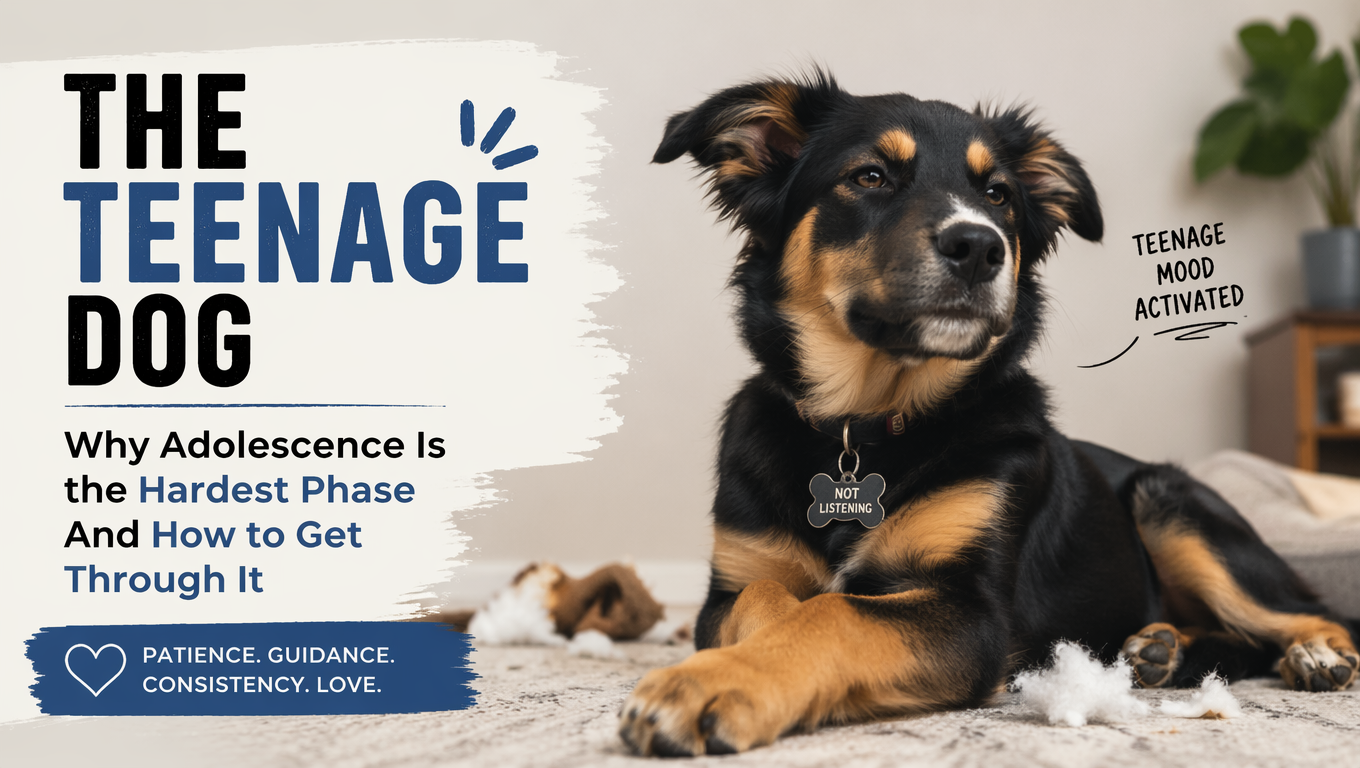
06 Jul The Teenage Dog: Why Adolescence Is the Hardest Phase (And How to Get Through It)
Your Adorable Puppy Has Been Replaced by a Tiny Chaos Agent
You did everything right, you attended classes or individual training sessions. You practiced the sit, down and recall until you were showing off to all your friends! You felt confident in your plan and you were confident.
Then…suddenly somewhere around six to eight months old your dog started to ignore you!
That puppy that used to follow you like a furry Roomba…gone. Replaced with a dog that when you call them they hear you, you know they can hear you, but now they are treating the recall as more a suggestion.
It’s important to know that you are not alone and you have NOT failed. Also, don’t let your dog fool you, they haven’t forgotten what you’ve taught them so far. This stage can feel frustrating, confusing and occasionally like somehow your dog got swapped out.
The good news is that this behaviour is a normal part of development. It’s also important to know that this phase doesn’t last forever.
What Actually Happens During Dog Adolescence?
This usually begins somewhere between five to six months of age for smaller breeds, a little later for larger breeds. Many dogs don’t fully mature until somewhere between eighteen months and two years old, some larger breeds can take even longer.
In other words, your dog isn’t just being difficult for a few weeks. In fact, one study from Newcastle University found that dogs around eight months were more likely to ignore cues from their primary owner, despite responding to other people (You can read the full study here if you fancy some light reading.)
Sound familiar?
Your dog isn’t necessarily forgetting their training, they’re doing something arguably more irritating…they’re choosing whether to listen. Think of it as the canine equivalent of a teenager, who knows exactly what they’re supposed to do but has spotted something more interesting.
Adolescence also changes how interesting other things in the world are. It’s not that your dog has stopped loving you, it’s just that the environment is competing for their attention…and winning.
It’s important to note that this is NOT dominance, but a natural development.
The Signs You’re in the Thick of It
Not sure whether you’re dealing with adolescence or if your dog has simply decided to become a tiny menace overnight? Here are some of the classic signs.
They’ve ‘forgotten’ their training– This is usually the first thing owners notice. Suddenly commands you were sure your dog knew are now meant with a blank stare like ‘what?’
This can be frustrating, especially when you’ve put so much work into training. Don’t panic, the training is still there! It’s more that the dog is growing, becoming independent and becoming interested in the rest of the world.
Recall has gone out the window– A few weeks ago, your dog would come running back every time you called, like a little furry boomerang. Now, they stop and think about if they want to respond to your request and may decide whatever they were doing is more interesting.
This is common in stimulation environments where there are a lot of distractions. Now your recall is competing with other things in the environment…and not always winning.
They’re suddenly more reactive or anxious– Adolescent dogs can become more worried about things that never bothered them before. It’s important to remember that dogs process experiences differently as they mature.
If you notice your dog becoming more cautious or concerned, don’t panic. Slow down, support them and focus on building their confidence rather than forcing them though situations they’re struggling with.
Lead walking has fallen apart – Remember that lovely loose lead that you’ve been practising? It probably feels like your dog doesn’t.
They’re simply bigger, stronger and more confident about exploring all their environment…every leaf!
Lead walking often takes a temporary step backwards during adolescence, which is completely normal…annoying but normal.
They seem to enjoy winding you up – It seems they find the most annoying timing, like the minute your on the phone they have found something suspicious to chew, or bark a lot. It’s not personal!
Dogs repeat any behaviour that works. If a behaviour gets attention, even negative attention, they get what they want…a reaction, so they’ll do it again.
They’re testing every boundary going – This is the stage where dogs…explore their boundaries and how consistently they are enforced.
They’re gathering data about who they can push and how far and this can be quite exhausting.
Why This Phase Catches So Many Owners Off Guard
Many owners expect the hard bit to be when you first get the puppy. Don’t get me wrong, it’s challenging!
Then adolescence arrives and appears to take a wrecking ball to all that progress and it can feel as though you’ve gone right back to the beginning.
It’s important to remember that your dog hasn’t gone backwards but is going through a developmental stage. All the training and foundations you built have not disappeared!
This stage is also a vulnerable period where the relationship between a dog and their owner is the most vulnerable. The same study earlier (Here it is again if you want to read it) found that adolescence is the peak age where dogs are rehomed through rescue charities.
It’s easy to assume you’ve done something wrong but you have NOT. You are simply raising a teenager.
What Helps (And What Really Doesn’t)
The good news is that adolescence isn’t something you simply survive!
What helps
Keep training short and worth their while – An adolescent dog has a very short attention span…really short. The world is also full of distractions that are competing for attention.
Keep training sessions short, five minutes is often plenty and you may need to up how exciting the treats are. The dog that used to work for a piece of kibble (dry food) now might need to be upgraded to things like chicken, cheese, sausage but it has to be something that your dog considers valuable
Go back to basics without shame – If any of your training has fallen apart don’t feel ashamed that you may have to go back a step.
Think about working at shorter distances or in lower distraction environments and re-build success before increasing the difficulty again.
Manage as much as you can – Think about the equipment that can help, such as long lines and extending leads. There are even secure fields you can run your dog in safely.
You can practice with these to help practice safely outside and control what you can.
Increase mental enrichment – A tired brain is often far more useful than a tired body. Things like sniffing, problem solving, training games, scatter feeding, enrichment toys and food puzzles help dogs use their brain.
Try not to just increase exercise alone but also increase their mental enrichment.
Stay consistent – This can be difficult when you’re tired or frustrated but consistency matters.
This doesn’t mean being perfect, just be predictable and stick to boundaries that matter.
Notice what went right – It’s so easy to focus on what went wrong and overlook things that went well, like your dog being calm around other dogs or lead walking nicely for a bit or coming when called.
Watch out for these times and reward them as progress isn’t all or nothing, it’s more building these moments consistently.
What doesn’t help
Getting louder and more frustrated – While this is understandable it can often make things worse rather than better. The goal is to stay calm and help your dog make a better choice, even when you feel that choice should be obvious.
Giving too much freedom too soon – One common mistake owners make is assuming that because their dog was reliable at five months that they will continue to be reliable. Unfortunately, adolescence doesn’t always work like that.
Many dogs will need a temporary step back to help rebuild their training to match their confidence. It’s important not to see this as a step backwards but more sensible management.
Comparing your dog to other dogs – This can catch people out, it’s easy to see another dog of a similar age doing something, like recall well, that your dog is struggling with and wondering what you’re doing wrong.
The truth is that dogs move through adolescence differently, what some struggle with others seem to breeze through. There are a lot of factors that play a role, such as breed, temperament, training history and their individual personality.
When To Get Professional Support
The teenage phase is normal. All the signs mentioned earlier like the selective hearing and the sudden fascination with everything in the environment…except you.
Just because this is normal doesn’t mean that it’s easy and you don’t have to navigate it alone.
It may be worth seeking professional support if:
- Your dog’s behaviour, reactivity, fear or anxiety seems to be getting worse even though you are training at home.
- You are losing confidence in your ability to manage or train your dog.
- You’re worried about your dog’s behaviour around certain things, like other dogs, people or children.
- You find yourself feeling frustrated more often than you’re enjoying life with your dog.
A good trainer or behaviourist won’t judge you. In fact they’ve usually met plenty of adolescent dogs and know how challenging this stage can be.
An experienced professional can help you understand what’s driving the behaviour, identify what’s working and what’s not and create a plan tailored to your dog. Sometimes it’s a small adjustment, sometimes it’s a management strategy you have not considered.
The Good News
The bond you’ve built with your dog doesn’t disappear during adolescence, it just gets a little lost in all the other things going on.
One day, sometimes when you don’t notice they will start to make good decisions again, the training starts to click again and all your consistency starts to pay off.
As long as you keep showing up, stay consistent and adjust your expectations when you need to.
With patience and grace for both you and your dog you’ll all come out the other side…even if your dog insists on taking the scenic route.
Need a Hand With Your Teenage Dog?
If your dog is currently ignoring commands you thought were solid or making decisions you feel as questionable, you’re not alone.
Since adolescence can be one of the most challenging stages of dog ownership, but you don’t have to navigate this by yourself.
I offer one-to-one training and behaviour consultation across Christchurch, Bournemouth, Poole, New Milton, Ringwood and the wider Dorset and Hampshire area.
Whatever you need help with, no judgement. I will offer support, guidance and training tailored to your dog.
[Get in touch here] to find out how I can help or learn more about my [behaviour consultations] and [one-to-one training sessions].
ExoWatts
Posted at 20:10h, 17 JulyGreat content! Keep up the good work!
Cecilpalay
Posted at 08:59h, 07 OctoberFind recently updated information website