18 Jun Your Puppy at 8 weeks: What to Expect (And What to Actually Do)
Nobody Gives You a Manual
You’ve done the research. You’ve bought the puppy pads, the toys and a cosy sleeping space, whether that’s a crate, a puppy pen or a bed. You’ve also stocked up on the seventeen different types of treats the internist has assured you were absolutely essential. You’ve read articles, watched videos and joined puppy groups. You feel ready.
Then the puppy arrives in your home and promptly pees on the sofa, bites your ankle, cries and then falls asleep.
Congratulations, it’s going brilliantly!
The truth is, the pup doesn’t come with a manual when you bring them home. Every puppy is different and some days can feel like you’re making it up as you go along.
Puppies tend to develop in stages. So, what your puppy needs at eight weeks is different from what they need at 12 weeks, 16 weeks and beyond.
Each stage brings new behaviours, challenges and milestones. Knowing what’s happening developmentally can make those confusing moments feel a lot less overwhelming and help you support your puppy in the right way at the right time.
So, rather than trying to tackle everything at once, let’s break it down one stage at a time.
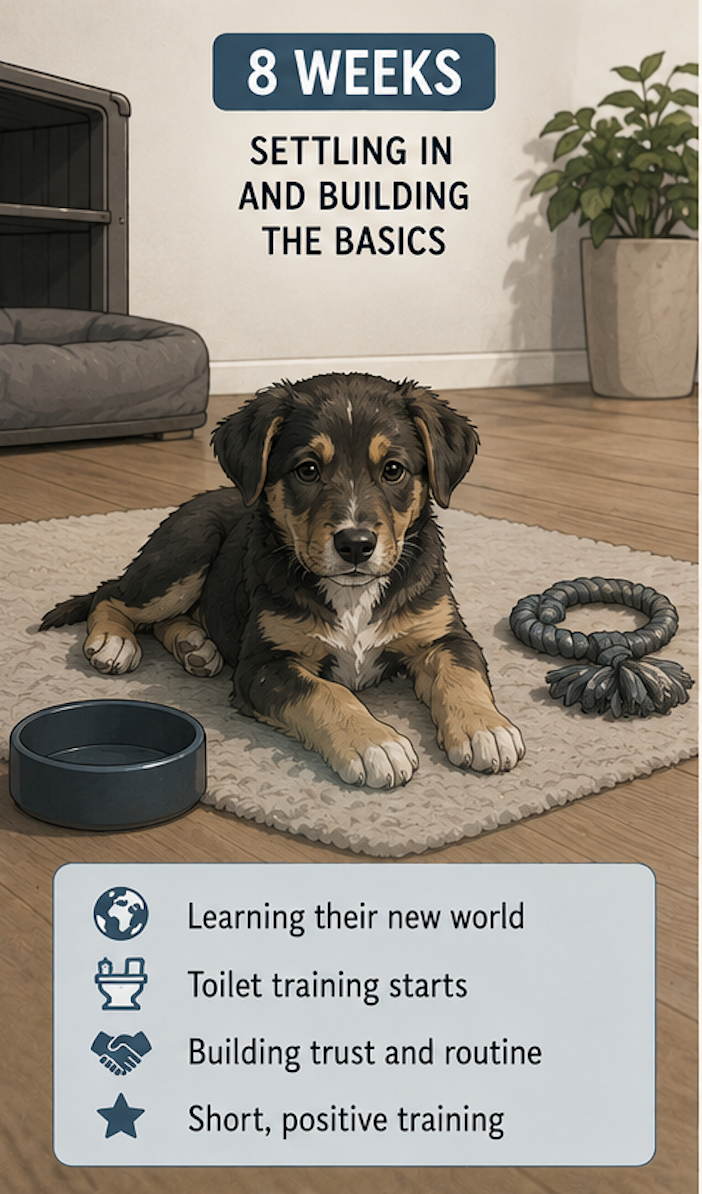
8 Weeks: The Brand New Baby (Who Bites Like a Piranha)
Eight weeks is typically when most puppies come home and this is a lot for a younger dog to process.
They’ve left all they were familiar with, like with the mum and siblings and are now in a new environment with lots of strange things like strangers, sounds and surfaces. Even the most confident puppy needs time to adjust.
At 6 weeks a slightly scary experience might be quickly forgotten, by 8 weeks experiences can start to leave a more lasting impression. This can include frightening encounters with other dogs or stressful visits to the vet. At this same time your puppy’s socialisation window is still wide open. This is also the period when their brain is most receptive to learning that the world is normal and nothing to panic about. While the socialisation window doesn’t suddenly slam shut at 12 weeks but it does gradually begin to close. So the experiences that your puppy has during their first few weeks at home really do matter.
Physically, your puppy is growing at an astonishing rate. Mentally, they’re learning every day. However, don’t be fooled, their attention span is measured in seconds rather than minutes!
What to actually do
Start as you mean to go on (but keep it gentle). – Start your training from day one!
That doesn’t always mean formal training sessions but more like lots of short, positive interactive sessions to help them learn how life works in your home. This includes things like where to sleep, eat, what to do with visitors. This should be more about building foundations rather than more formal obedience.
Prioritise feeling safe. – Since your puppy has just experienced one of the biggest changes of their life it’s important to let them explore their new environment at their own pace. Avoid overwhelming them with too many visitors or expectations as a puppy who feels safe can learn better.
For some puppies, it can help to start with access to just one room or a puppy pen before gradually introducing the rest of the house.
Socialise thoughtfully – You don’t necessarily need to wait until after all the vaccinations to introduce them to the world, this should always be checked with your vet first. Depending on the advice you’re given your puppy may have restrictions on what they can do and interact with.
That is normal.
Socialisation isn’t just about meeting as many dogs as possible. It’s about helping your puppy learn that the world is a safe place. You can always carry them, letting them observe different people, sounds, surfaces and environments. Keep all experiences positive and short.
Expect biting, plan for biting. – If your puppy seems to have the teeth of a piranha, you’re right on schedule. Mouthing and nipping are completely normal at this stage. Puppies explore the world with their mouths, practise bite inhibition and are beginning the journey towards teething. Redirect them onto appropriate toys, keep play sessions short and make sure they’re getting enough sleep.
Many puppy owners spend weeks wondering if they’ve accidentally adopted a small shark…you haven’t. This is all normal and does pass.
Reward the behaviour you like. – At this stage, training isn’t really about focusing on dedicated sessions but more about noticing the things that your puppy is already doing that you want to encourage and then making those worthwhile to your pup.
Be ready to reward anything including (but not limited to) settling quietly, choosing a toy and not your shoes, if they look at you when you use their name.
It’s important to remember that the reward doesn’t have to be food every time, it can be fuss (either vocal or touch) or toys. The more the dog is rewarded for these choices the more they will choose to do these behaviours.
Toilet training is a marathon, not a sprint. – One of the most common frustrations for new puppy owners is toilet training. The reality is that puppies under 12 weeks simply don’t have full bladder control yet.
Accidents happen and are just part of the process.
Take your puppy outside regularly, especially after sleeping (including naps), eating, drinking and playing. When they get it right, praise!
When they get it wrong, clean it up and carry on. No drama or punishment.
This requires patience, consistency…and a good supply of kitchen roll.
If your puppy is currently chewing a table leg, hanging off your trouser leg, or causing absolute chaos all morning, you’re not alone.
I offer puppy training and one-to-one sessions across Christchurch, Bournemouth, Poole, New Milton, Ringwood, and the wider Dorset and Hampshire area, tailored to you and your puppy.
[Get in touch here] to find out how I can help, or learn more about my [puppy training].
*Picture generated by AI
No Comments